
Step Bends
Sheet Metal Bend Types
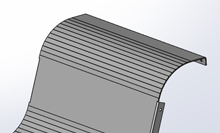
Step Bends
Short overview video
Bending is a key process in sheet metal fabrication used to shape flat metal sheets into custom components and enclosures. At Protocase, sheet metal is bent with a press brake or folder in order to form custom electronic enclosures and parts.
Any metal that is bent will have a radius along the inside of the bend. While we can achieve very small bend radii down to 0.04” (1.02mm)*, our capabilities also extend to creating very large bend radii using a process called step bending (or bump bending).
This process involves making a series of small, consecutive bends to form a large, smooth curve.
If your project requires sheet metal enclosures or parts with a large bend radius, this allows us to manufacture them precisely to your specifications.
*View our Bend Radii & Minimum Bend Sizes page for more information.
What is Step Bending in Sheet Metal Fabrication?
Step bending, also referred to bump bending, is the process of taking a large bend radius and dividing it up into multiple smaller bends in order to approximate a larger radius. Instead of using a single large die, a press brake machine performs multiple "bumps" or bends in close succession along the metal sheet.
Our press brake machinery can complete many bends in succession in order to achieve radii of 1.0” (25mm) or more, as long as size limitations are met.
Step bending can be very useful for achieving a curvy look for aesthetic purposes without needing customized tooling.
Sequence of Step Bends
Step Bend Examples
Material Limitations
We are able to complete step bends on all of the sheet metals we stock, with the exception of two materials:
Perforated Sheet Metal: Since this material is pre-cut with the circular cutouts, the location of the holes are uncontrolled. As a result, we cannot step bend perforated sheet metal consistently.
6061 Aluminum: This general-purpose alloy is well suited for CNC machining, but it is brittle and prone to cracking when bent. 5052 aluminum is the optimal choice for sheet metal fabrication, including step bending.
Material Thickness & Radii
The spacing between step bends is limited by the size of the bending die used. The thicker the material, the larger the bending die must be in order to ensure accurate bending while minimizing wear to the machine and tool.
For the smoothest bending and ideal end result, we recommend minding these values:
| Material Thickness | Die Size | Minimum Step Bend Radius | Nominal Deviation From Radius |
|---|---|---|---|
| ≤ 0.051”| 1.295mm | 0.236" | 6mm | 0.38" | 9.652mm | 0.005" | 0.127mm |
| ≤ 0.064” | 1.626mm | 0.315" | 8mm | 0.61" | 15.494mm | 0.005" | 0.127mm |
| ≤ 0.129” | 3.277mm | 0.630" | 16mm | 2.41" | 61.214mm | 0.005" | 0.127mm |
If you require a smaller radius than the minimum mentioned above, contact us to discuss your options.
Size & Radii Limitations
Ultimately, there is no upper limit on the overall bend radius that can be achieved when using step bending. However, certain size limitations will dictate the bend radii that can be achieved:
Maximum flattened part size is 47”x95” (1193.8mm x 2413mm), as our sheet metal typically comes in 48” x 96” sheets, and our lasers require a 0.5” (12.7mm) space around the perimeter for affixing the sheet to the laser beds.
Thinner materials that are of the maximum dimension have an increased chance of the material bowing during the bending process.
If you a require an enclosure or part with step bends beyond the constraints listed above, contact us to discuss your options.
U-Shape Limitations
Step bending opens up the possibility of bending U-shaped enclosures that are much taller than they are wide. However, to ensure your design is manufacturable, you must consider the following constraints:
For a U-shape profile 6.1” (154.94mm) or less in height: The bend radius must be 0.7” (17.78mm) or larger to provide clearance for the tooling.
For U-shapes taller than 6.1” (154.94mm): The bend radius must be 1.7” (43.18mm) or larger to clear the ram.
For 180-degree radii: The spacing between each bend may need to be increased to accommodate positioning tabs. Our Engineering & Design team can assess your design's feasibility.
If your design includes large bend radii that don't meet these limitations, we may still have a solution. Contact us to discuss your project's specific requirements.
Holes Within Step Bends
Placing cutouts or holes within or near a traditional bend is not recommended because the cutouts will stretch and distort.
However, step bending, which uses multiple small bends to create a large radius, allows for circular cutouts to be placed very close to the bend line, or even within the bend itself.
Two general rules of thumb:
Circular cutout dimension should be smaller than are equal to 0.250” (6.35mm).
The cutouts should be widely spaced.
Finishes
Custom parts and enclosures with step bends are able to be finished with virtually any of our finishes, so long as the parts fit within the dimensional constraints and other requirements.
However, it’s important to note that step-bent parts with no finish will display visible tooling marks. On the other hand, cosmetic bare metal finishes like grain finish will have these marks cleaned up.
Number of Steps Within a Bend
You will be advised on the number of steps within the step bend once you share your design with us. If you have any questions, contact your Account Manager.
Step Bend Tolerances
The flange size tolerance is ±0.010” (0.254mm) per 10 steps (minimum ±0.010”).
The angular tolerance is ±1° per 10 steps (minimum ±1°)”.