
Jog Bends
Sheet Metal Bend Types
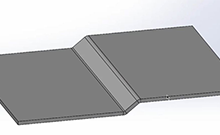
Jog Bends
Short overview video
What are Jog Bends and Material Offset Bends?
While jog bends and material offset bends achieve a similar result, the means by which each bend is created is different.
Material offset bends are preformed in a single operation. The tool used for material offset bends has an imprint that will form the metal with a singular offset. These will typically raise your bend up by the material thickness.
On the other hand, jog bends are preformed in two separate operations. Jog bends are a more manual method of achieving parallel distances, and enable larger distances than material offset bends. Jog bends offer greater flexibility as you are not limited by the single tool and operation.
These bends keep the part on either side parallel to each other, in order to provide an offset surface. These can be used to allow space for a cover to sit on top of an enclosure while remaining flush with the outside.
Jog bends and material offset bends are often used for adding clearance to a design, such as adding an offset lid that is tucked inside your design.
Sequence of Jog Bends
Jog Bend Examples
Materials for Jog Bends
We can create jog bends and material offset bends on many types of sheet metal, including aluminum, cold rolled steel, galvanneal and stainless steel.
Jog Bend Design Constraints and Guidelines
Ensure there is enough clearance between your offsetting flanges and the inside of the cover. We recommend a clearance between 0.010” (0.254 mm) and 0.020” (0.508 mm).
Finishes
Parts with jog bends or material offset bends can be treated with any of our finishes, so long as the part meets the minimum and maximum dimensions for the particular finish you choose.